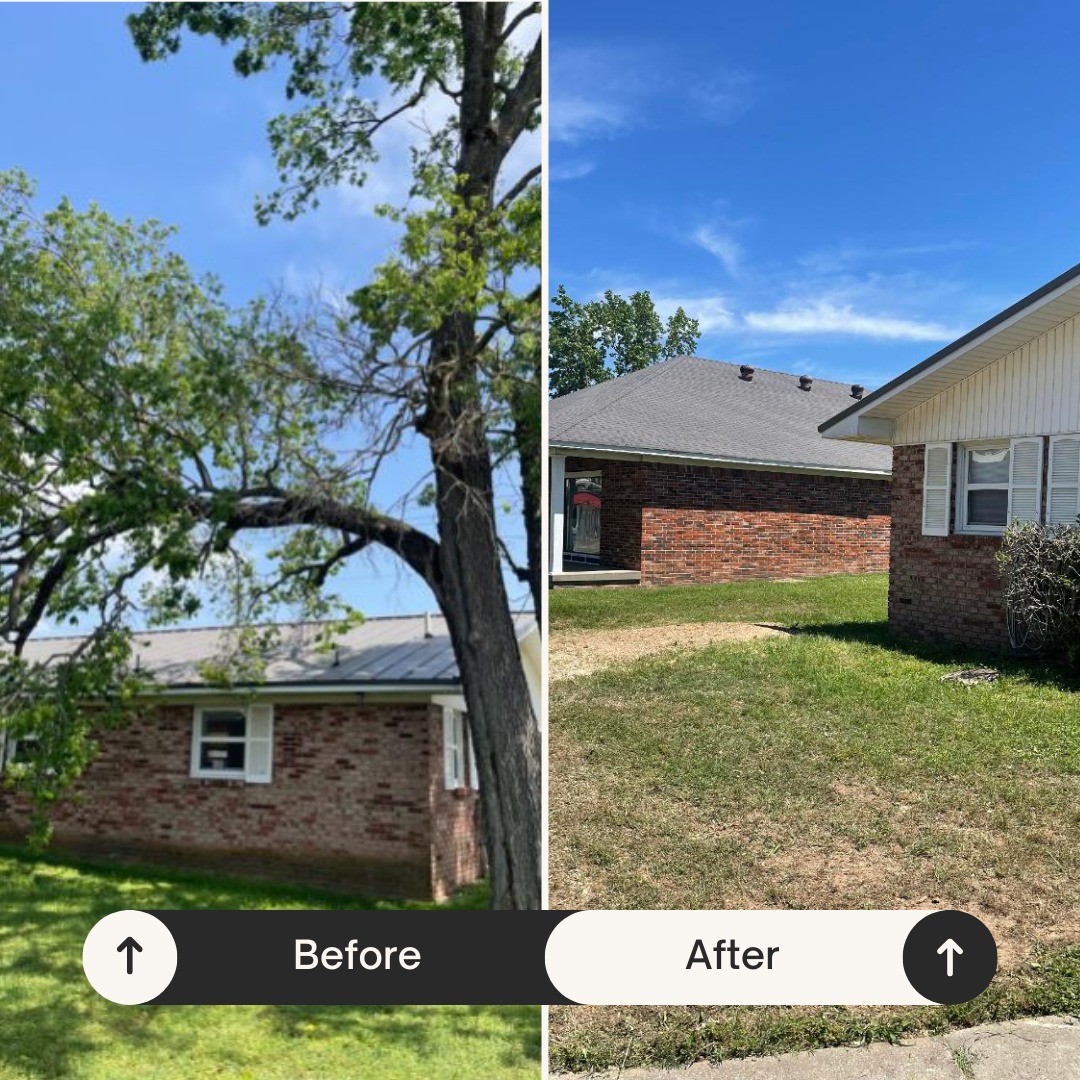
Oak trees are the backbone of the Ozarks landscape. Drive through any neighborhood in Branson, Springfield, or Harrison, Arkansas, and you’ll find these majestic hardwoods shading front yards, lining creek beds, and anchoring decades-old properties. Red oaks, white oaks, post oaks, and black oaks are woven into the identity of this region.
But oak trees in Missouri and northern Arkansas are under serious threat. According to the Missouri Department of Conservation, oak decline has been an escalating problem across the Ozarks, driven by recurring drought cycles, aging forest stands, and a growing list of pests and fungal diseases attacking weakened trees. The red oak borer, two-lined chestnut borer, Armillaria root rot, and Hypoxylon canker are all active in our region — and they do their worst damage before most homeowners notice anything is wrong.
A dead or dying oak on your property isn’t just an eyesore. It is a safety hazard. A large oak branch weighs hundreds of pounds. A full tree can weigh several tons. When these trees fall, they take out roofs, fences, vehicles, and in the worst cases, people.
Here are 5 signs your oak tree may need to be removed — and what to do if you spot them.
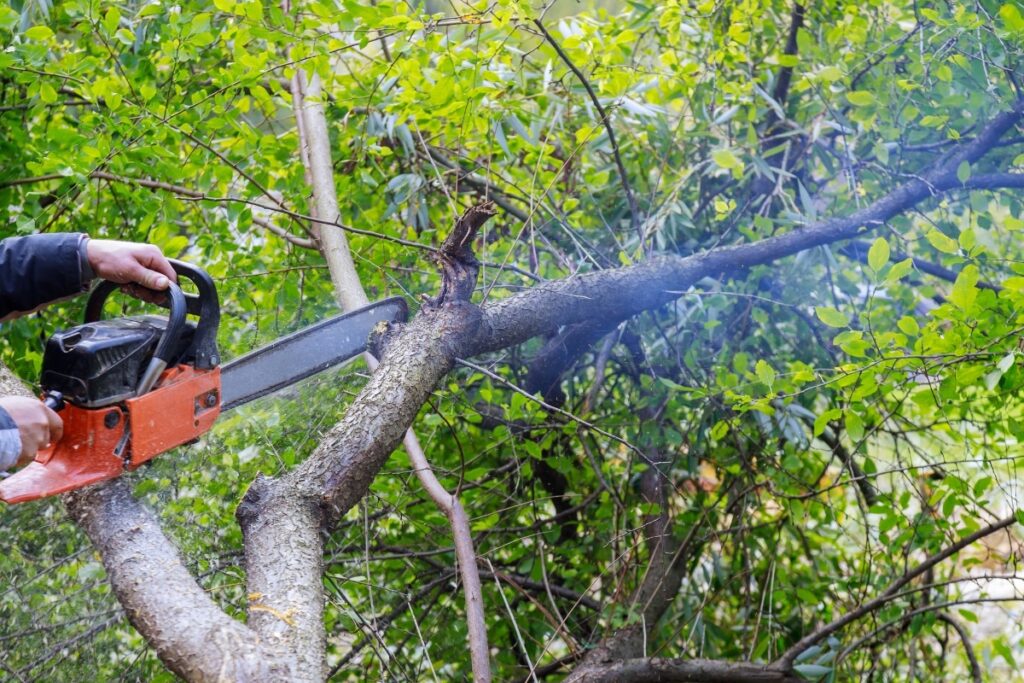
Sign #1: Thinning Canopy and Dead Branches at the Top
One of the earliest and most telling signs of a declining oak tree is what arborists call “dieback” — a progressive die-off of branches starting from the top of the canopy and working downward. Healthy oaks push new growth every spring. If you look up at your tree and notice large sections of bare branches where leaves should be, or if dead limbs are appearing year after year in the upper crown, that tree is telling you something serious.
In the Ozarks, canopy dieback is most commonly caused by:
- Oak decline syndrome – a combination of drought stress, Armillaria root rot, and Hypoxylon canker that systematically shuts down the tree’s vascular system
- Red oak borer and two-lined chestnut borer infestations – larvae tunnel under the bark, disrupting the flow of water and nutrients from roots to branches
- Oak wilt – a fast-moving fungal disease that can kill red oaks within weeks of infection
When dieback affects more than 50% of the canopy, removal is usually the safest course of action. A certified arborist can evaluate the extent of damage and give you an honest recommendation. If you’ve noticed this on a tree near your home in Branson or Springfield, call RB Hardwoods Tree Service for a free assessment before the problem gets worse.
Sign #2: Bark That Is Cracking, Peeling, or Falling Off
Bark is a tree’s armor. When you see large sections of bark cracking, splitting, or sloughing off in sheets, it is a signal that something has gone deeply wrong inside the tree. This is especially alarming when the exposed wood underneath looks dark, discolored, or wet.
In the Missouri Ozarks, bark deterioration on oaks is frequently tied to:
- Hypoxylon canker – a fungal infection that moves through drought-stressed oaks, killing the cambium layer and causing bark to peel away in distinctive gray-brown patches
- Borer damage – exit holes from red oak borers (roughly the size of a pencil eraser) punched through the outer bark are a sign larvae have been feeding inside for one to two seasons
- Post oak decline (POD) – now widespread across the Ozarks according to USDA Forest Service monitoring in 2025, post oaks are showing heavy bark sloughing and dieback across southern Missouri
If the bark on your oak is actively falling away and you can see galleries or channels carved into the wood beneath, the tree is in critical condition. This is one of the clearest signals that tree removal in Branson, Springfield, or Harrison is necessary before the structural integrity of the tree fails entirely.
Sign #3: Fungal Growth at the Base or On the Trunk
Mushrooms and bracket fungi growing at the base of your oak or along the trunk are not a quirky landscape feature — they are a red flag. Fungal growth on a living tree almost always indicates internal wood rot, which destroys the structural integrity of the trunk from the inside out.
The most dangerous fungi associated with oak decline in Missouri include:
- Armillaria root rot – produces clusters of honey-colored mushrooms at the base of the tree in fall. This fungus attacks the root system first, and by the time mushrooms appear above ground, the root system may already be severely compromised
- Ganoderma (shelf fungi) – flat, shelf-like brackets that grow directly from the trunk are a sign of advanced internal decay. A tree with large shelf fungi near the base can fail without warning
A tree suffering from root rot may look relatively normal from a distance — until a storm pushes it over. Our ISA Certified Arborists at RB Hardwoods have assessed hundreds of trees across Branson and the surrounding Ozarks, and root rot is one of the conditions we take most seriously. Do not wait on this one.
Sign #4: The Tree Is Leaning or Has Raised, Exposed Roots
A tree that is noticeably leaning — especially if that lean has increased over a season or two — is showing a compromised root system. Similarly, soil that is cracking or heaving on one side of the tree, or roots that are lifting out of the ground, means the tree’s anchor in the earth is failing.
This is a structural emergency. Unlike diseased trees that may have months before they become critical, a leaning oak with a failing root system can fall in the next storm. Given the severe weather that rolls through Branson and Harrison, AR each spring, this is not a risk worth taking.
Important distinction: not every leaning tree needs removal. Some trees naturally grow at a slight angle toward light. What triggers concern is a sudden or progressive change in lean, or a lean combined with any of the other signs on this list. An arborist inspection will quickly tell you whether the lean is cosmetic or structural.
Pro Tip from RB Hardwoods
If your oak is leaning toward your house, a fence, a vehicle, or a power line, treat it as an emergency. Call us at 870-688-9870 day or night. Our emergency tree removal service in Branson is available 24/7.
Sign #5: The Tree Has Suffered Major Storm Damage and Won’t Recover
Branson and the surrounding Ozarks get battered by severe thunderstorms, straight-line winds, and ice storms every year. Oaks are resilient, but there is a threshold beyond which a storm-damaged tree cannot recover. When an oak loses a major scaffold branch, develops a split trunk, or suffers bark stripping down the main stem, it is open to infection and structural failure that can progress rapidly.
Signs that storm-damaged oaks are unlikely to recover include:
- More than one-third of the main canopy is gone after a storm
- The trunk is split or cracked at a major crotch point
- A large wound is exposed on the main stem with no signs of callus tissue forming around the edges
- The tree lost roots when a neighboring tree fell and pulled the soil
This is especially relevant for homeowners in Harrison, Arkansas and Springfield, Missouri who dealt with significant storm events over the past couple of seasons. Damaged oaks that are left standing without assessment often become a liability within 12 to 24 months as decay fungi colonize exposed wood.
When Can an Oak Tree Be Saved Instead of Removed?
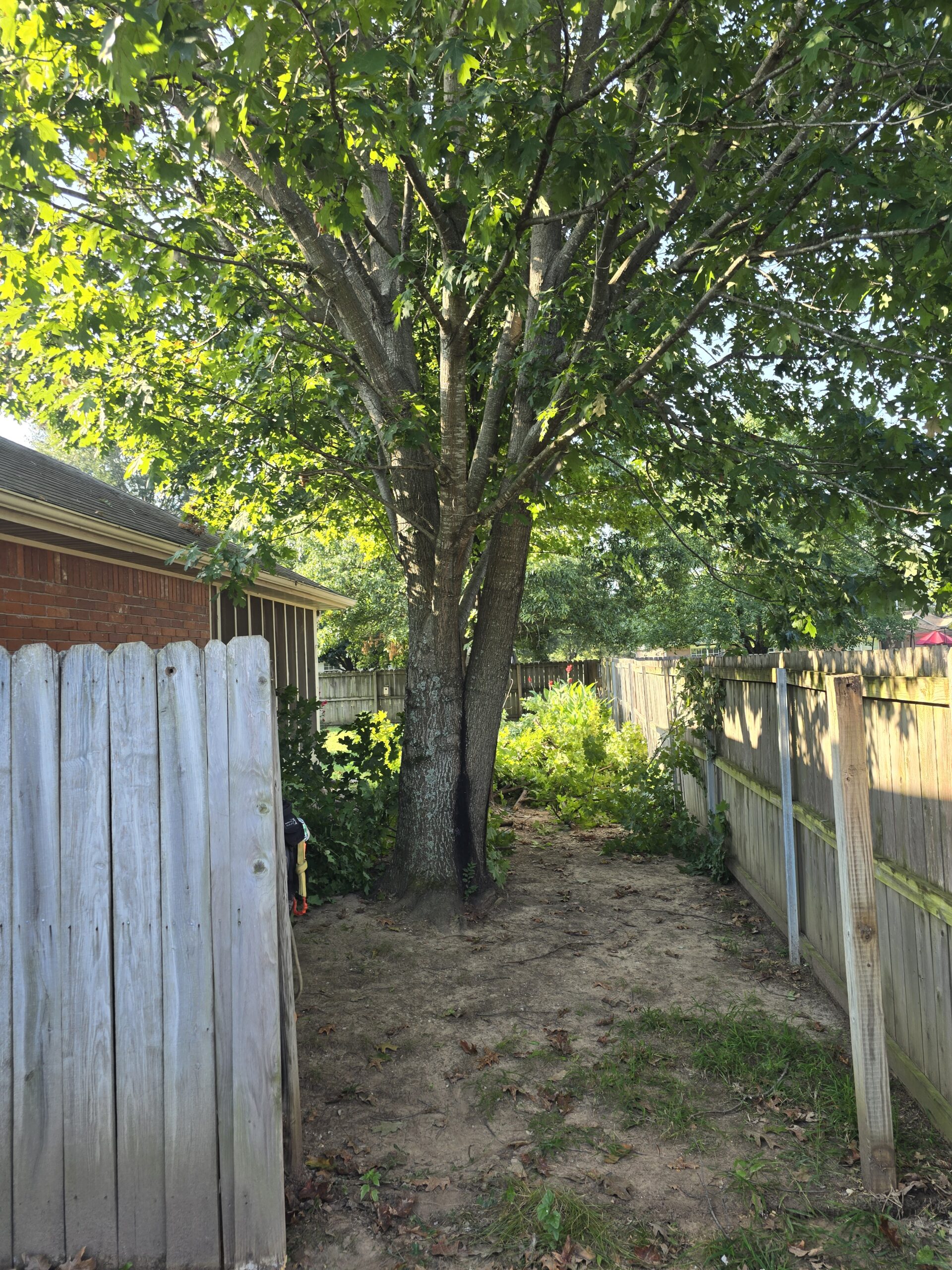
Not every sick oak needs to come down. Some trees can be rehabilitated with targeted pruning, soil care, and pest treatment — especially if the problem is caught early. Our team at RB Hardwoods will always give you a full picture and tell you honestly whether a tree is worth saving. We have no incentive to recommend removal when trimming will do the job.
Trees that may be candidates for saving rather than removal include:
- Oaks showing early-stage canopy thinning with no signs of borer exit holes or root rot
- Storm-damaged trees that lost one major branch but retain a strong, sound trunk and root system
- Trees where the problem is isolated to one side of the canopy and the structural core is intact
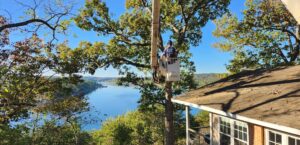
Our tree trimming service in Branson can remove dead wood, reduce the weight load on compromised branches, and improve airflow through the canopy — all of which help a struggling oak fight back. We also provide tree climbing services in Branson to safely access high canopy damage that ground-level inspection cannot properly assess.
Why Local Knowledge Matters for Oak Tree Removal in the Ozarks
Oak decline in Missouri and Arkansas is not a generic tree problem — it has a specific regional profile. The combination of Ozarks soil conditions, drought history, and the specific pest species active in Stone County, Taney County, and Boone County Arkansas is something a locally experienced arborist understands at a level that a national franchise simply cannot match.
RB Hardwoods Tree Service is locally owned, family-operated, and has been working in the Branson area for over 20 years. Our ISA Certified Arborists know the difference between a post oak showing normal seasonal stress and one in the early stages of Post Oak Decline. We serve:
- Branson, MO and all surrounding Taney County communities
- Springfield, MO and the surrounding Greene County area
- Harrison, AR and Boone County, Arkansas
- Shell Knob, Kimberling City, Reeds Spring, Forsyth, and Lampe
Worried About an Oak Tree on Your Property?
Don’t wait until a dying oak becomes an emergency. RB Hardwoods offers free estimates and 24/7 emergency tree removal in Branson, Springfield, and Harrison, AR. Our certified arborists will give you a straight answer — no pressure, no hidden fees.
Call Now: +1 870-688-9870 | 24/7 Emergency Tree Service Branson
rbhardwoodstreeservice.com | Free Estimates | Licensed & Insured
Whether you are dealing with a declining red oak behind your home in Branson, a post oak showing bark problems in Springfield, or a storm-split white oak on your Harrison property, RB Hardwoods Tree Service is your trusted local partner. We are your tree services company in Branson that genuinely cares about the health of your landscape — and the safety of your family.
If you spotted any of the five signs in this guide on a tree near your home, don’t wait. Give us a call today at 870-688-9870 for a free, no-obligation assessment.